Showing posts with label learning activities. Show all posts

2/18/2014

Teaching Tuesday: Objectives

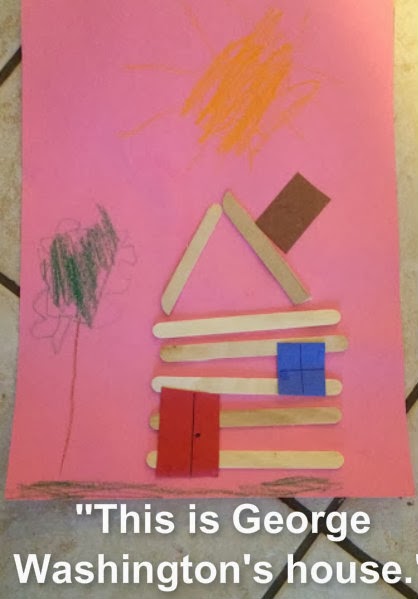
Last week, Hugmonkey actually completed a project at Tot Drop, which is the drop off care at our gym. Usually, Hugmonkey just plays. But this time he proudly showed me this:


I glanced at the Tot Drop teacher nearby, and she smiled and said, "No, remember it's. . . ."

Blank look from Hugmonkey.

"You see I made grass and a tree and the sun? I did details," he said, totally avoiding the subject of whose house it was.

"I really like how you added details to your log cabin," I replied, finally figuring out what the point of the project was.

With much more prompting from the teacher, Hugmonkey finally acknowledged that he'd made Abraham Lincoln's birthplace. Which, despite my history nerd tendencies, I didn't really care about. It pains me when I hear about preschoolers who can recite the presidents in order or kids who've been forced to memorize Shakespearean sonnets.

Whats the point of knowing the presidents if you can't describe their role in government? Why memorize Shakespeare if you can't understand what it means? Why does it matter if my five year old knows that Abraham Lincoln grew up in a log cabin?

Don't get me wrong, I liked the project. For his fine motor skills, not his presidential history skills. My kid is five; to him my entire childhood is ancient history. Abraham Lincoln is about as real to him as Cinderella and probably a lot less real than Santa Claus.

"What's your objective here?" I remember my mentor asking as she pointed to an activity in my lesson plans. I had just started to take over the class and my cooperating teacher was always like, "Looks great, see ya!" as she ran out the door. I can't even remember the activity, but I do remember asking, "I have to be able to articulate an objective for everything I do in the classroom?"

Now, I happen to be really good at bull-shitting, so it's not like I couldn't come up with an objective for everything I was doing. But I hadn't thought of it that way before; I hadn't realized that I should come up with the objective before the activity. But it's informed everything I did as a teacher and everything I do as a parent; everything thing we do has an objective.

Even if that objective is getting them to be quite for five minutes straight and that activity involves turning on the television.

My issue, which seems to be with the Common Core, the Tot Drop teachers and way too many moms on pinterest, is that so many objectives are completely inappropriate. I read one blog post about an activity for preschoolers, except the mom recommended parents doing steps 1, 3, 4 and 5 of the 5 step process. The objective appeared to be making an attractive centerpiece, which means preschoolers probably should not have been involved at all.

I'm toying around with coming up with learning objectives for the kids, not just academic ones but life skills ones as well, because I need frameworks. And I don't trust any school - no matter how great on paper - to cover everything I want them to know.

If you were coming up with objectives for your kids, or kids in general, what would you list?


1/07/2014

Teaching Tuesday: Math Fact Magic

I have never used anything I (allegedly) learned in high school geometry, advanced algebra or trigonometry. Which is good, because I'm pretty sure I just memorized things for the tests. It's also good that I had no interest in being an engineer or. . .um, anything else that involves higher level mathematical thinking. But to be brutally honest? I'm not sure I've ever used any mathematical knowledge I developed after seventh grade. I mean, if I'd learned about checkbook balancing, interest rates and whatnot, that would have been handy. But I didn't.

Even more sad? I didn't really understand basic math until I was in grad school. I mean, I knew how to the math problems that did come up in my life, but only by using the formulas I had memorized. I had no facility with numbers and wasn't sure of the multiplication facts for 12 until I was actually teaching elementary school.

Do not let this happen to your kid.


First of all, I absolutely believe in having your kid memorize addition, subtraction, multiplication and division facts. The more, the better. I would suggest going to 20 with addition and at least 12 with multiplication. Math facts are like the sight words of math - if you don't have to struggle over each one, your problem solving is a lot more fluent. So you'll want your kiddo to spend some time doing basic memorization drills. Here are some suggestions for making it less painful:


  • Have them make their own flashcards, or cards to trade with a friend. Buy some index cards at the dollar store and let them use markers to write. Practice with them for 5 minutes a day. 
  • Let them play online math fact games. FunBrain has Math Facts Baseball, really simple but way more fun for kids than worksheets or flashcards. ABCya has Math Facts Basketball, which is a little more complicated but the focus is still on the facts. Both of these can be used for addition, subtraction, multiplication and division. 
  • Then you can go the tablet route and have them play games on there. For Kindle Fire and Apple products, check out Math Bingo, Squeebles Math games, Operation Math and Medieval Math Battle. 
  • Skip count. If you can skip count, you'll always have a quick to figure out multiplication facts. Don't just do 2s, 5s, and 10s - do 3s, 4s and all the rest up to 12. 
  • Have kids create a version of a board or card game, but with math facts instead. For example, have them make Candyland, but instead of colors, have the spaces on the board be numbers and the cards be math facts. 
But if you want your kids to develop an actual understanding of math facts, you have to go beyond games and activities that involve simply regurgitating the facts. You have to make them understand, manipulate and extend the facts. 

  • Make a deck of numeral cards - use index cards to make 3 sets of numerals from 1 through 10. For younger kiddos, you might want to have dots on the back side that match the numeral, such as 3 dots on the back of the 3 card. With this deck, you can play the Make 10 game. With Make 10, each person gets 5 cards. On each turn, you try to use two of your cards to "Make 10". If you can't make 10, you must draw from the pile until you can. You can make the game about addition, subtraction, multiplication or division by changing what the goal number is - Make 20, or Make 3, and so on. You can also make a deck of numeral cards using 10, 20, 30 and so on to 100. Then play similar games, but with the higher values. 
  • Try Witzzle. This is one that I never used in my classroom, I just happened to see it on Pinterest and I think it's brilliant. 
  • Have them make fact anchor charts for especially challenging facts. 
http://indulgy.com/post/DbjA9EBZJ1/anchor-chart-multiplication


11/19/2013

Teaching Tuesday: Flashcards

When Ironflower was a baby, someone gave her a set of picture flashcards. They were lovely photographs of things like fish and horses, each with the word printed on the front and some facts to share on the back. Ironflower loved them. She loved to chew on them and fling them under the couch.

I don't think I ever made it through one of the fact paragraphs before she yanked the card out of my hands.


Which just goes to show that Ironflower was born being pretty damn smart; babies do not need flashcards, they need conversations. In other words, if you're reading this post because you want to use flashcards with your baby, toddler or preschooler, step away from the computer and play with them instead. Or chat with them as you go for a walk around the block.

That said, I am not against all flashcards. For older kids, flashcards can be a great way to memorize sight words, math facts and foreign language vocabulary. But there's no need to waste money on buying flashcards; have kids make their own with markers and index cards. Then spend 5 minutes every day on them.

When I taught, we practiced with flashcards every single day. A few minutes during reading, a few minutes during math. In reading, I would hold up a flashcard and the kids would say the word ("The!"), spell the word ("T! H! E!") and say it again. In math, they would say the whole number sentence. So if I held up a card that said, "4 + 6", they would say, "4 + 6 = 10". I usually focused on 10 cards at a time, 5 for kids who were struggling. After a week or so, I would test kids individually on the cards to see if they were ready for the next set. When testing, I considered them "correct" if they got the correct answer within two seconds. The point of sight word, and math fact, flashcards is automaticity, after all.

Vowel digraphs, like "oo" and "ou", can also be memorized through flashcards. I have to admit to being terribly lax about doing flashcards with my own kids, but now that work is getting a little more difficult for Ironflower, I'm probably going to start. I want her to know her multiplication and division facts through 12 and her Greek/Latin suffixes and prefixes before the year is over. Of course, Lovebug will undoubtedly jump in on this and be twice as bored in third grade as he is in second but I guess it'll be practice for all the boring meetings he'll have to sit through some day.

7/30/2013

Teaching Tuesday: More Summer Notebook Ideas

About a month ago, I posted about helping kids learn over the summer through summer notebooks. I actually remembered that I promised to include more ideas later in the summer, which, if you know me at all, is kind of a miracle. Half the time I can't even remember to set up reminders on my phone the right way.

Anyway, not only did I remember that I was supposed to do it, I am actually doing it. I just hope you find it helpful.


1. Have them make acrostic poems with their names or other special words (let them use a dictionary):
For example:
     Joky
   Energetic
   Noisy

2. Have them make a graph of a bag of M&Ms or Skittles, showing how many colors there are of each candy.

3. Have them calculate the money needed to start a lemonade stand (how much to buy lemonade, how much to "rent" a table from you, how much to make posters) as well as how much they'll make if they sell 10 cups for $.25 and $.50.

4. Have younger kids copy a picture you make from simple shapes, like a snowman and a train.

5. Hand over some old coupons or the Sunday supplement, give kids an imaginary budget and let them figure out a grocery list. This would also work with toy or clothing catalogs, as long as your kiddo was fine with the "imaginary" part.

6. Have older kids turn a short scene from a book into a short play, with appropriate stage directions and dialogue.

7. Have them use index cards to make their own math flash cards, with answers on the back.

8. Have them create a board game about a specific topic, such as Harry Potter, addition facts or dinosaurs. They can write the directions in their summer notebook, then use poster board and index cards to make the actual game.

9. Have them write a persuasive letter to get you to change your mind about a family rule or habit; Ironflower's is about why she should be able to get her ears pierced.

10. Have them write haiku (17 syllables - 1 line of 5, 1 of 7 and 1 of 5) about their favorite summer activities.