Showing posts with label Teaching Tuesday. Show all posts

5/06/2014

Beyond the Worksheet

Hugmonkey loves worksheets. His teacher has started sending some home for homework (no comment) and he has the best time doing them. There was a time when Lovebug and Ironflower felt the same way, but that was before they completed a couple hundred of them. Now, if I want them to learn at home - which I definitely do, at least during the summer - I can't exactly hand them a grade level workbook. 

Well, I could, but I want them to actually enjoy learning.

Beyond the worksheet.


  • The whiteboard. You can use it like you would a worksheet - have them copy words or practice math facts, but for some reason they find it way more fun. 
  • Let them create their own worksheet and answer key for any subject. Then you or a sibling can complete it. 
  • Make an alphabet book. For little ones, this can just mean writing a letter at the top of a page and drawing a picture of something that starts with that letter. When that's too easy, they can think of several words for each letter and draw those words. For older kids, they can research a favorite topic like sea animals or monster trucks and complete an alphabet book about that subject, with facts and a drawing for each letter. 
  • If you've got kids close in ability levels you can have them create and trade math story problems. 
  • If you still get catalogs (and if you've got an American Girl-aged girl I know you do, I'm pretty sure they have a contract with the NSA to be alerted of all 7 year old girls), give your kids a budget and let them pretend to shop from the catalog. 
  • Have them figure out how to double and/or halve their favorite recipes. 
  • Make them create a book, play, poem song and/or dance to help practice math facts, state capitals or whatever else they need to practice. 
  • Encourage kids to take surveys and compile the data in different ways. If your family has a holiday gathering every year, let your kids ask all the family members for their favorite desserts, then create a graph depicting that. 
  • Create a website. Have kids make a book review blog and encourage them to post at least once a week. 
  • Encourage them to create a math picture dictionary. They can devote each page to one math term and include its meaning and an example. 
  • Develop a family journal and let each kid be responsible for recording family activities one day a week. 
  • Use a "number of the day" concept. Choose a number and encourage kids to come up with number sentences that total that number. 

4/15/2014

Math Magic: Cheap and Easy Math Games

I've talked about the importance of helping kids develop number sense.   Part of that includes memorizing math facts for addition, subtraction, multiplication and division. And the easiest way to get kids on board with doing extra math is through games.

I am a HUGE fan of cheap and easy games. Nothing depresses me more than spending lots of time and money on what I think is some great activity, only to have my kids get bored with it after two seconds. So, to play these games (many of which I've borrowed from other games or stolen from the math curriculum I used to teach), you'll need index cards, a marker and some dice.


You're going to make math cards with your index cards. 
  • For younger kids (first grade and under), you'll want to write the numbers 0 - 10, 1 per card (see above). Make 2 or 3 sets, depending on how many people will be playing the games with you. Imagine one set per player. 
  • You'll also want to make dot card sets. Instead of writing the numerals, you'll make dots of the numbers from 0 - 10. Like this:

  • For older kids, you'll want your sets to go from 0 - 20, again making one set per player. You won't need dot cards for them. 
  • You should also make money cards, showing at least $.25, $.50, $.75 and $1. Other amounts are up to you and your child; whole dollar amounts might be best for some kids, while odd amounts like $.37 might be most important for others. 
  • Save time by having the kids make their own. 
Math Go Fish

In Go Fish, 7 cards are dealt. Then each player lays out any matched pairs in his or her hand. Instead of matching pictures or colors, have kids match numerals with dot cards. So if you have a card with 5 dots, the match would be the card with the number 5 on it. Next, the youngest player asks the other play for a card s/he wants, like "Do you have a card with 3 dots?" The other player must share it. If s/he doesn't have it, s/he says, "Go Fish". Then the player takes a card from the pile in the middle. Whoever pairs off all of his/her cards first is the winner. 

Make 10

This game can be played exactly like Go Fish, except instead of matching the goal is to have the two cards add up to 10. So if you had a 4, you would want a 6, because 4 + 6 = 10. You can alter this game for any number, really. Make 20, Make 12 and Make 15 are good alternatives. When your kiddo is ready to work on subtraction, then you can try Make 1 or Make 2. You can even play this game with smaller multiplication facts. 

High Low

Place value, also known as understanding that the "1" in "17" really stands for a 10, is an important part of number sense. In this game, each player is dealt 2 (or 3, or 4, or 7, depending on ability level) 

cards. Each card will represent a place in the final number. Whoever has the highest number wins. So, if you were dealt a 3 and a 6, you would make the number 63 because that's higher than 36. For the next hand, you would try to make the lowest number.

Money Race

You'll need to dip into your change purse for this game. Pile a large bunch of pennies, nickels, dimes and quarters onto the table. One player flips over money card and each player uses the change to create that amount. Whoever makes the correct amount first is the winner. You can make this game more challenging by removing the pennies from the money pile.

Compare

In this game, players compare their cards against the other player's. Basically, you split the deck in half and each player pulls the top 2 cards from his/her deck. For kids working on addition, the idea would be to add the 2 cards; for kids working on subtraction, the idea would be to subtract the smaller from the larger; for kids working on multiplication, the idea would be to multiply the two cards. Then whoever has the bigger amount would collect all the cards and put them to the side. Whoever has the must cards at the end (when the original decks run out) is the winner. This game can be extended all sorts of ways. For very little ones, players could just pull 1 card and determine which number is bigger. For older kids working on division, you can make cards with higher numerals to add into the pile so kids can divide and compare.


Subscribe to TripleZmom, not Supermom by Email

4/08/2014

Number Sense: Teaching Mathematical Thinking

Just like comprehension is the entire point of learning to read, number sense is the entire point of learning math. I don't know about you, but I don't have the time to walk through the grocery store using a calculator app to determine if each sale is truly a good deal. But because I have (some) number sense, I can estimate quickly as I walk through the aisles.

I don't think anyone talked about number sense when I was a kid. Math then was really focused on memorization. I remember I once failed a multiplication test  - despite being the first kid done and despite checking over my work - because I had forgotten one step in the formula I had memorized. Had anyone emphasized number sense in any of my math lessons, I probably would have realized that 470 isn't a large enough answer for 37x48. 


It wasn't until I was learning to teach math that I begin to develop number sense. I was TWENTY-FOUR when I made the connection between skip counting and multiplication. Yet I was able to do pretty well on the math portion of the SAT. Isn't that sad?

I used to joke that I had teach younger kids because I couldn't understand fourth grade math well enough to teach it. Except that I wasn't really joking. And I've heard so many people, mostly women, talk about how bad they are at math. But you know what? I think it's just that we have lousy number sense. I was lucky enough to develop mine when I learned how to teach a math curriculum that focused on number sense.

So what can parents do at home - even parents who feel like they are "bad at math" - to help their kids develop number sense?


  • Stop pushing your toddler to count to 20 or 100 or whatever. Rote counting doesn't have much bearing on future math ability.
  • Do encourage your little one to count objects. One to one correspondence (touching 1 car and saying 1, touching the next car and saying 2 and so on) is far more important. Kids under 6 should have one to one correspondence equal to their age; a 4 year old should be able to count 4 objects accurately. 
  • Sorting objects - blocks, cars, stuffed animals, rocks, whatever - is helpful, as long as you discuss how kids sorted them. Color? Size? Shape? Encourage your kids to explain their thinking.
  • Use math vocabulary and make sure kids understand what the words mean: before, after, between, more, less, difference, even, odd. For older kids, include: fraction, factor, sum, percent, addend, area, perimeter, length, volume. There's a great list for older kids here
  • Show kids how you use math every day. Talk about balancing the checkbook, calculating coupons and sales, figuring out the tip, measuring for recipes and so on. Share how you figure things out, even if it's not the "official" way you learned in school. 
  • Play games that involve math skills, like Yahtzee, dominoes, Sorry, Connect Four, Chutes and Ladders, Uno and even poker. 
  • Incorporate a few math problems or stories into your bedtime rituals. Show kids that math is just as important as reading. If coming up with your own problems intimidates you, check out these helpful books:


Amazon Affiliate links. If click on one of these and order, I will earn (a teeny bit of) money. 

Come by next Tuesday for descriptions of easy math games you can play at home. And let me know how you feel about math and number sense in the comments!


4/01/2014

A Quick Guide to Reading Components

This is a repost of my first Teaching Tuesday post from last summer. Mainly because I have the nastiest cold and I can't think straight. But also because I'm much better at pinnable images now. 


The Basic Components of Reading

Exploritude. 

Is totally not a real word. But were you able to pronounce it? That's phonics.


High-dray-shun.

Also not a real word, but if you put the sounds together quickly it sounds like a real word. That's phonemic awareness.

Peter Piper picked a pack of pickled peppers. 

If you read that quickly three times, that's fluency. Also any time you read a word without having to sound it out phonetically.

I was born in a summer month that has 31 days and starts with "J". The sixteenth of that month is exactly two weeks after my birthday. 

If you now know when my birthday is, that's comprehension. Also, logic. They kind of go together.

Loquacious. Hydroponics. 

Those are cool vocabulary words that don't come up in everyday conversation. But the bigger your speaking vocabulary the easier reading will be.

The Dirty Truth

If your kid is struggling with and/or dislikes reading,  s/he is struggling with one or more of these components. If your kid's teacher can't tell you which one(s) s/he is struggling with and how you can help, then there's a problem with the teacher. Any teacher who can't articulate why a student is struggling with reading shouldn't be teaching reading.

3/25/2014

Educational Jargon: Translated

Like any other profession, education has its own language of obscure words, acronyms and phrases that only sort of sound like what they actually mean. But while it's totally possible to enjoy a play without knowing what the proscenium is or where stage right is, it's a bit harder to enjoy your kid's educational experience if you don't know what the raw score or a rubric is.

Tire swing shadow.

Ability Grouping: This one is what it sounds like; grouping kids based on their ability. How that ability is determined is something you should find out, though, if you hear that term being thrown around a lot at your kids' school. If they're basing the entire year's math class on one standardized test, that's not the best of use of ability grouping.

Assessment: An opportunity for teachers to assess student knowledge. We used to call them tests. Today there are all different kinds, though.

  • Adaptive: Usually taken on a computer, adaptive tests adjust the questions based on how the child does on the beginning questions. Questions will get more difficult when the child answers correctly and easier when the child answer incorrectly. 
  • Criterion-Referenced: Measures student performance based on goal, objectives or standards.
  • Diagnostic: A test prior to instruction, or used to find out a new student's strengths and weaknesses.
  • Formative: Not so much a test as a checkpoint during instruction, to see that kids are on the right track.
  • Interim/Benchmark: These might include tests given before every grade card or based on some other time requirement. 
  • Norm-Referenced: Measures student performance by comparing it to a national or other "norm" group of peers. 
  • Performance: Students demonstrate their knowledge through a hands on activity. 
  • Summative: The end of year or end of unit test on what students have learned. 
Differentiated Instruction: Want to impress an educator? Ask how the new curriculum provides for differentiated instruction. Differentiated instruction is when teachers adapt lessons and curricula so that students of all levels are appropriately challenged. Unless your child is the most average learner in every single subject, you want him/her to have differentiated instruction. 

IEP or Individualized Education Plan: A legal document that lays out goals, accommodations (such as having a longer time for tests or a paraprofessional helper) and services that need to be provided to a child with a disability, as defined by the IDEA law (the individuals with disabilities education act). If your child is struggling but does not qualify for an IEP, there are 504 plans, which create learning plans for students and list the accommodations they need. 

Rubric: A numerical guideline used to grade assignments. Each number in the guideline would have certain requirements, with the highest number (often a 4 or a 5) reserved for students who go beyond the assignment, such as writing 8 sentences instead of the 5 required. The next number down (a 3 or a 4) would be for students who completed the the 5 required sentences correctly. And so on. 

Ummm. . . I just wrote a lot more than I had planned to. And this doesn't even cover half the words I was going to talk about. What do you guys think? Is this useful? Or does everyone just Google stuff anymore? These are just a few of the words other parents have asked me about in the last 6 months or so, because people know I used to be a teacher. I figured that if people are asking, it means that the Google response was probably overwhelming (like when I Google medical questions) and that this might work for a Teaching Tuesday post, but I don't know. 

Is there any jargon you'd like me to translate? Or should I go back to ranting about educational topics? I want your honest opinion. 


3/18/2014

Teaching Tuesday: Surviving Standardized Tests

Contemplative kid.

Let me preface this by saying that although I believe all schools in our country need to have high standards and regular assessment of students, I am not a fan of standardized tests. I think any time students need to be taught HOW to take a test (rather than actual educational material), our educational system is screwing up. High stakes testing, wherein students, teachers and schools are judged by how kids do on multiple choice tests that last from a day to a week out of the school year, is a huge concern for a lot of people. You can check out Fair Test and the American Evaluation Association for facts, studies and expert opinions. 

Ironflower had only been in third grade for a few weeks when she mentioned the NJ ASK test, the standardized test kids take in NJ in third through eighth grades (which will probably be switched the the PARCC test next year, which is the standardized test that goes with the Common Core Standards). She was already nervous and the test wouldn't be until late spring.

Ironflower is nicknamed "Ironflower" for a reason; she looks like a delicate flower, but she's actually pretty tough. She also has an easy time with tests. She is never unnerved by the format or worried or tense. And yet, there she was, expressing anxiety 7 months ahead of time. Apparently her teacher had already started talking to her class about how important the test was, how they would be prepping for it all year (!!!) and how it would be more challenging than other tests they had taken.

It was a great way to drain the self-confidence out of kids like Ironflower and probably scared the crap out of all the kids who aren't good test takers. Not that I blame the teacher; when you're going to practice for something all year, you need to explain why to your students. So what can parents do to help their kids survive standardized tests? Assuming they don't opt out of them, of course.


  • Reassure kids that how they do on these tests has no influence on their college prospects, future jobs or lifelong happiness. 
  • Explain that teachers and administrators make a big deal out of the tests because the school's test scores are used to measure teacher and administrator effectiveness.
  • Make sure they get lots of rest and healthy breakfasts during testing. 
  • Let kids know that test taking is a skill like scoring soccer goals or playing an instrument and that these tests are not a reflection of intelligence, kindness or diligence. 
  • If your kids' school does a lot of preparation for the tests, don't push more of it at home. A burned out kid isn't going to do any better than an unprepared kid. 
  • If your kid tends to rush, remind him/her to go back and look over questions and answers when s/he completes the test. 
  • If your kid tends to agonize over uncertainty, encourage him/her to skip frustrating questions and go back to them after completing the rest of the test. 
  • If your kid is really nervous, give him/her a lucky bracelet or shirt or something to wear during testing. 
  • Even if your kid is generally terrible at taking tests, express confidence that s/he can do well on this test. Confidence really is half the battle. 
  • Send in an extra special snack on test days. Even if your kiddo doesn't normally get to snack in school, they might allow it on test days. 
Whatever the outcome, remember that the test is just one (small) indicator of how your kid is doing academically. 

3/11/2014

Teaching Tuesday: Super Science Ideas

It wasn't until I was in graduate school for education that I learned science could actually be fun. And that learning science concepts didn't always have to involved a dry textbook or a dead frog. In the hopes that my kids learn to like science before their mid-twenties, our family went to Super Science Saturday last weekend. Even if you don't live in north Jersey, though, there are lots of Super Science Saturday activities at museums, schools and colleges around the country.

Science ideas for kids.
There were drones. They didn't fly them, though. 

Science for kids.
There was a flight simulator. 

And there were tons of experiments by local kids. 

Looking at bacteria. 

Science experiments for kids
Creating static electricity. 

One of my favorite experiments; creating colored flowers. 

Some kids were stationed by there experiments so they could explain them. 

Making paper airplanes. 

Flying paper airplanes.

I have still never held a snake. 

My kids are braver than I am (except for Hugmonkey). 


But you don't have to go to a science event or museum to teach your kids about science. And you also don't have to buy expensive sets or do a ton of work for them to learn about science. I promise.


  • For babies and toddlers: Okay, life is pretty much a science experiment for babies and toddlers - dropping the cup on the floor 8 million times is just a way to test gravity, after all. Provide soft blocks, cups for the bath and experience with textures like sand and grass and you've covered baby science. 
  • Preschoolers: Building with blocks and riding bikes are an excellent intro to physics. For biology, you can have them grow some bean plants or even just have them help in the family garden. Chemistry can be covered by cooking together, or letting them mix paints and/or play dough colors. 
  • Early elementary grades: There are so many great options for this age group. Have them test the distances their paper airplanes can fly and figure out which styles or materials fly best. Grab some white carnations and put them in cups of water, then add food coloring to the water and watch what happens to the flowers. Let them figure out the fastest way to make an ice cube melt. Encourage them to cook with you more, to try out different types of seeds or watering schedules in the garden, to make their own play dough and to make predictions about the world around them. 
  • Intermediate grades: If they're big Lego fans, try Lego Robotics. They can also try building ramps for the skateboards or bikes. I've seen kids become obsessed with figuring out which brand of microwave popcorn pops the most, or which stain fighter is most effective. 
If you need more ideas, there are great books with lots of science ideas:


3/04/2014

Teaching Tuesday: Higher Learning

I have never actually taught high school or college. I subbed in a high school for one day, in the resource room. I've also tutored a couple of high school students and I had a college-aged education student in my classroom for a while. But I don't really have any professional expertise in this area.


Except, of course, the fact that I went to high school and college. Neither prepared me to be a functional adult. Here's an abbreviated list of things I did not learn, but are required for functional, educated adults:

1. How to understand mortgages, interest rates and checkbook balancing.
2. How to choose car insurance.
3. How to understand health insurance. 
4. How to write a resume.
5. How to write a cover letter.
6. How to write a business plan.
7. How to budget.
8. First aid and CPR.
9. How to analyze statistics.
10. Any African, South American,  Asian or ancient history. (it's worth noting that I was a history major in college)
11. The basic tenets of world religions. (Technically, I did learn these in college, in an elective class that hardly anyone else took.)
12. How to speak another language, or several other languages, well enough to get along in a foreign country.
13. How a car works and/or at least basic car maintenance.
14. How to handle a job interview.
15. Anything about computers. Not that it would be relevant now, but still.
16. How to cook, sew or repair anything.
17. How to make a presentation.
18. Any kind of media literacy.
19. Public speaking strategies.
20. The metric system.


Also, I didn't learn to dress appropriately under my graduation gown. 


I did learn a few things that have come in useful (beyond the fact that I can't drink Jaegermeister without deeply regretting it the next day and that doing your own laundry sucks):

1. Cultural literacy. I read a lot of Shakespeare and other famous (mostly white, mostly male) authors. I also saw a lot of classic movies, listened to all kinds of music and tried cuisines from all over the world.
2. How to take excellent notes.
3. How to write a grammatically correct paper very quickly.
4. American and European history from the Middle Ages onward.
5. How various kinds of birth control work.

And a few more things that have not come up again in my life:
1. Higher level algebra
2.  Volleyball
3. Trigonometry
4. How to conjugate verbs in French (never used, despite visits to several different French-speaking countries).
5. Chemistry
6. The ability to dissect small animals (one could argue that this would be useful for future surgeons, but I'm pretty sure using computer programs of the human body would be a lot more useful - for everyone - than an intimate knowledge of frog anatomy)
7. Knowing the names and major works of every Renaissance artist (and thus I lost any interest I'd had in art history).


The reason I bring all this up, besides my bitterness about being forced to play volleyball for an entire semester of gym class, is that it doesn't sound like high schools are doing much better today in preparing their students for functional adulthood. When you talk to people who teach college, or graduates looking to get a job with a future, you hear nothing but complaints. Hell, look at most job listings; the skills companies want are rarely covered by common curricula, especially at the high school level.  Time Magazine's February 24th cover story talks about how one group of public high schools is looking to change that, and that's what got me started on this rant.

The former teacher in me has a strong urge to write a comprehensive list of things I would like my kids to know by the time they graduate from high school and another list of things I would like them to know by the time they graduate from college. Because by judging from my first list (which totally could have kept going), there's a lot of important stuff that their high school (despite it's great reputation) is not going to teach them. And if either of them winds up a liberal arts major in college, well, we're going to have cover even more stuff.

Which is not to say that I don't think kids should learn the liberal arts, or the math that will lead some of them into engineering and whatnot. I just think we need to balance it with some practical stuff.

Did you feel prepared for adulthood after high school and/or college? Did you learn more practical stuff than I did?


2/25/2014

Teaching Tuesday: Drive Me Crazy

"Phonics or Whole Language?" the other mom asked me abruptly. My confusion must have shown in my face; as far as I knew, we were making small talk in 2014, not attending a teaching conference in 1994. "You said you used to teach reading, so what do you believe in, phonics or Whole Language?" she seemed almost aggressive about it, like she was dying to argue with me.

Except, as far as I know, that argument was settled a long time ago.

Lovebug needed me at that point, so our conversation ended. But naturally, I couldn't just let it go. I went home and started Googling.

Reading curricula debates drive me crazy.


"Whole Language", by the way, is not the memorization of whole words at the expense of phonics - despite what some web sites and California school districts of the '90's would have you believe. But it did focus on meaning and context, instead of phonics and phonemic awareness. When I was in graduate school, the talk was all about Whole Language - the idea of teaching phonics and grammar and vocabulary in the context of real literature, with a strong focus on comprehension. And then, my first teaching job was as a long-term first grade substitute in a district that used an extremely structured, phonics-based reading curriculum called Open Court. Basically the anti-thesis of everything I had been taught in graduate school.

Both times, most of my students learned to read.

Then I moved to Kansas City, Kansas and started teaching first grade there. My first year, there was no reading curriculum. I was the only first grade teacher who had actually taught before, so I cobbled together info from the Open Court curriculum I'd subbed with (and taken a class on) with what I'd learned in grad school.

Again, most of my students learned to read. Though I did have more students who had missed out on early literacy experiences, so not as many of them reached fluent status.

The next year, KCK began using Guided Reading, also known as Balanced Literacy, as its reading curriculum. I liked how it combined my favorite things about the phonics curriculum and whole language, but I was dismayed by how many colleagues didn't know how to teach it.

To teach reading well, you have to understand phonemic awareness, phonics, comprehension and vocabulary acquisition on a deep, deep level. Most teacher training programs (back then, anyway) did not foster that deep understanding.

And when I say "teach reading well", I mean teach ALL of your students to be good readers. A competent teacher doesn't need a lot of support to teach kids with typical abilities and parents who read to them every night to read. But kids who learn differently, or didn't hear stories until they went to kindergarten, need reading teachers who are better than competent.

And they also need teachers (and schools) that aren't married to one particular curricula or methodology. That was my issue with Reading Recovery, which is a one-on-one program for kids who are slightly behind the reading curve in first grade. The only difference was that it was one-on-one, otherwise it was the exact same curriculum used in the classrooms. It reminded me of  Americans speaking more loudly to people who don't understand English, instead of looking for alternative methods of communication.

We need to stop doing the same thing more loudly with kids who aren't reading on grade level; we need to try something completely different. We need to stop asking, "Phonics or Whole Language?" and start assessing (truly and deeply, not on bullshit standardized tests written by underpaid freelancers for monolithic testing companies) where each student is lacking.

It has always driven me crazy that so many districts, or other powers that be, latch on to the latest thing every few years, as if it's going to be a cure-all for whatever's causing kids to fail. Also, the belief that having standards is somehow the same as actually teaching kids to reach those standards bugs the crap out of me. As does the concept that every child can be successful being taught the exact same way, if only we test them enough, or make the teachers document enough.

2/18/2014

Teaching Tuesday: Objectives

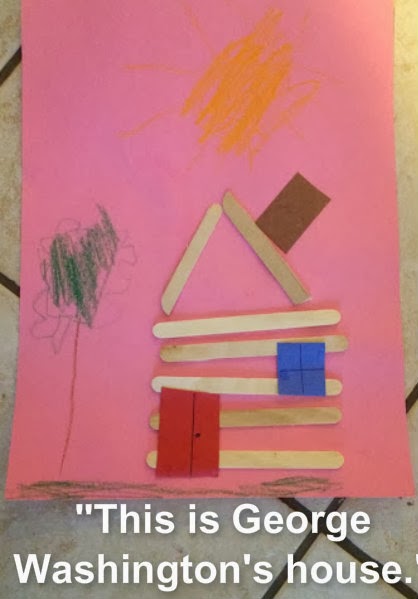
Last week, Hugmonkey actually completed a project at Tot Drop, which is the drop off care at our gym. Usually, Hugmonkey just plays. But this time he proudly showed me this:


I glanced at the Tot Drop teacher nearby, and she smiled and said, "No, remember it's. . . ."

Blank look from Hugmonkey.

"You see I made grass and a tree and the sun? I did details," he said, totally avoiding the subject of whose house it was.

"I really like how you added details to your log cabin," I replied, finally figuring out what the point of the project was.

With much more prompting from the teacher, Hugmonkey finally acknowledged that he'd made Abraham Lincoln's birthplace. Which, despite my history nerd tendencies, I didn't really care about. It pains me when I hear about preschoolers who can recite the presidents in order or kids who've been forced to memorize Shakespearean sonnets.

Whats the point of knowing the presidents if you can't describe their role in government? Why memorize Shakespeare if you can't understand what it means? Why does it matter if my five year old knows that Abraham Lincoln grew up in a log cabin?

Don't get me wrong, I liked the project. For his fine motor skills, not his presidential history skills. My kid is five; to him my entire childhood is ancient history. Abraham Lincoln is about as real to him as Cinderella and probably a lot less real than Santa Claus.

"What's your objective here?" I remember my mentor asking as she pointed to an activity in my lesson plans. I had just started to take over the class and my cooperating teacher was always like, "Looks great, see ya!" as she ran out the door. I can't even remember the activity, but I do remember asking, "I have to be able to articulate an objective for everything I do in the classroom?"

Now, I happen to be really good at bull-shitting, so it's not like I couldn't come up with an objective for everything I was doing. But I hadn't thought of it that way before; I hadn't realized that I should come up with the objective before the activity. But it's informed everything I did as a teacher and everything I do as a parent; everything thing we do has an objective.

Even if that objective is getting them to be quite for five minutes straight and that activity involves turning on the television.

My issue, which seems to be with the Common Core, the Tot Drop teachers and way too many moms on pinterest, is that so many objectives are completely inappropriate. I read one blog post about an activity for preschoolers, except the mom recommended parents doing steps 1, 3, 4 and 5 of the 5 step process. The objective appeared to be making an attractive centerpiece, which means preschoolers probably should not have been involved at all.

I'm toying around with coming up with learning objectives for the kids, not just academic ones but life skills ones as well, because I need frameworks. And I don't trust any school - no matter how great on paper - to cover everything I want them to know.

If you were coming up with objectives for your kids, or kids in general, what would you list?


2/11/2014

Teaching Tuesday: Good Schools Have

When Ironflower started kindergarten, it was a common (now banned) practice for the parents to wait in the hallway where the kids lined up, at least for the few minutes until the para-educator got there. Since she was in afternoon kindergarten, this meant that I got to observe the third graders returning to their classrooms from the lunch room.

It freaked me out.

Not only were the kids not in line, they were talking. There would just be this big group of chattering, happy kids surrounding the teacher as they walked down the hall. I had never seen anything like it.

My students had to be in a straight line in the hall. They had to be silent. They had to have their arms folded so that they wouldn't touch each other. The worst was trying to get them to do that after lunch or recess (Kansas law dictated that recess and lunch could not follow or precede each other, which really just wasted a lot time with lining up twice as much and finding something not too time-consuming to do between the two), when they were all hyper and happy. Making them walk around like prison inmates always cured that. It sucked.

If you have a choice about where your kids go to school, or are moving and looking for new schools, please visit the school if you can. Preferably around lunch time. A good school isn't just about test scores. It's about the attitudes of the staff and students, it's about opportunities, it's about the culture of learning.


  • No problem with prospective parents wanting to visit
  • Students who can walk through the halls without having to keep their arms folded
  • Actual student work on the walls, not cutesy pre-made bulletin boards. Or even worse, nothing. 
  • Recess. Recess is vital to kids' well-being and districts who don't realize that are way, way, way behind the times. 
  • Art, Music and PE. The broke, urban district I taught in prioritized these classes; I think it's one of the reasons that it's one of the more successful urban districts in the country. 
  • Classrooms that are neither eerily quiet nor chaotically loud
  • Staff members who can manage kids without yelling at or speaking over them
  • Plans in place for disasters. It's horrible to think about, but it's even more horrible to think of tragedies that could have been prevented or lessened with disaster drills/plans in place. Think of it as just a step beyond the fire drill.
  • Grade level teachers who work and even possibly teach together. In first and second grade reading, for example, you can have a massively wide range of abilities. Last year, Lovebug didn't have a reading group for a while, it was just him meeting occasionally with his teacher - he thought he was in trouble. It was just that no one else in his class was on the same reading level, but I guarantee that with 3 other first grade classes, there were other kids in the grade on his level. Why have each teacher try to manage 7 or 8 levels in their room instead of mixing kids up into appropriate levels for the reading period? I don't know. 
  • Parent volunteer opportunities that are genuinely helpful. I student taught in an urban district in Portland, then did a lot of subbing and long term subbing in a Seattle suburb. We didn't necessarily have a lot of parent volunteers, but the ones we did have came in to help with actual, important tasks - correcting papers, working with individual students, cutting out the construction paper shapes needed for a math lesson and so on. In Kansas City, we very rarely had parent volunteers, except on some field trips. And then there's here, where there are a ton of volunteers that photograph everything and do elaborate crafts, but (despite there being legions of former teachers and tons of smart people) never get to do anything academic. It seems silly and wasteful of resources. 
  • Options for when the copier breaks down. I think worksheets can have their place, but if that's all the kids do? If that's all you see in the hanging in the hallways? If that's all you see kids doing? Then there's a problem. No one should be too upset if the copier breaks down for a few days.
  • No open positions. The positions in good schools fill up fast, because people actually want to work there. 

2/04/2014

Teaching Tuesday: That's Rank

Do the kids still describe gross things as "rank"? 

Because my title is a lot funnier if they do. Anyway. . .


Recently the New Jersey school rankings came out. Well, in New Jersey they're called "performance reports" and schools aren't technically ranked, but you know what I mean. One thing that I really like about the New Jersey reports, as opposed to the reports in Kansas (where I taught), is that schools are compared with a peer group of schools as well as the rest of the state.

For example, my kids' school, when I see their percentages of kids at the proficient level on state tests, I can also see the percentages of kids at the proficient level at schools* with similar economics, demographics and resources. This is way more meaningful than comparing their scores to those at the state level - the state has districts even fancier than ours, but it also has a lot of districts with a lot of severe challenges. And I'm not saying that kids in those tough districts can't excel, because they absolutely can, but it's harder. I just think you can get a clearer picture of how well students are testing when you compare kids who get enough to eat/have beds/aren't woken up by gunshots/have enough books in the classroom with other kids who have the same privileges (not that those things should be privileges).

I find the sections which separate test takers into groups like race, gender and special education status not especially interesting. Unless there's a huge difference between genders or races, obviously that would be a red flag that the school has serious problems, regardless of their overall test scores.  As for special education, that's just frustrating. "Special education" is such a broad term incorporating kids who learn perfectly well, but may have physical challenges like blindness, and kids who may learn exceptionally well but have a challenge like Asperger's and kids who have serious challenges to learning, like Down Syndrome. So when you look at how the kids identified as "special education" test, you don't know what issues the kids have and whether the school is doing a good job meeting their needs or whether the kids just test very well.

Then you have to realize that as of right now, anyway, each state has different tests. In 2014-2015, all states that have adopted the Common Core will use the same assessments. Regardless of how you feel about the Common Core, this will be the first time that we can actually compare states fairly. Twelve (or so) years ago, I helped write practice tests for the Kansas 4th grade math assessments. One of the things we did was check out other state assessments; that was eye-opening. Kansas fourth graders had to know the same things as Pennsylvania's fifth graders, for example. No wonder our kids looked worse on paper!

Test scores cannot be the only way to rank a school - or a student, for that matter. Scores don't even tell you whether the school is educating students or training them to take the tests well. And they certainly don't tell you about the culture of a school; do the teachers care? Do the parents volunteer? Are the students taught to be kind to one another? Is it okay to exclude? Does everyone value learning? Or test scores?

I've yet to see a site where schools are ranked accurately and fairly, Great Schools and Schooldigger notwithstanding. And so many times the culture of a school can change quickly, depending on who the principal is or whether the school tested well the year before. The school experience can even vary from family to family, or kid to kid. But there are some things to look for, when you're ranking schools for a move or a change.


  • The existence of a Parent-Teacher Organization, or PTO. This shows that parents are will to try to help the school and take an active part in what goes on there.
  • The existence of a district educational foundation. This group focuses on raising money for extra programs like field trips and presentations and extra supplies like iPads. 
  • Rising test scores. Unless the scores were very high to begin with, in which case you'd want them to be remaining steady. 
  • Art. Music. PE. Recess. Reducing or eliminating these activities shows the district does not prioritize what's best for children and/or cares way more about test scores than actual learning. 
  • High teacher retention. You may only be able to get this info for the district level - and you may have to call the board of education and ask - but it's still worth it. If teachers are quitting or fleeing to other schools/districts after a couple of years, there's probably a problem. 
  • A principal who's willing to meet with you and hopefully give you a tour of the school. If the principal doesn't have time to meet with prospective parents, good luck talking to him/her if your kid has a problem. 
  • School size and class size. I like an elementary school with fewer than 500 kids; I think you don't get as much cohesion and collegiality in bigger schools. I've never heard of any data that supports smaller schools and class sizes meaning higher scores, but they do make better experiences for teachers and students. 


*One of the schools in our peer group is Nut Swamp Elementary, which strikes me as completely hilarious. I can only hope the town's high school has the same name. 

1/28/2014

Teaching Tuesday: Back Off


Since the evil stomach virus came to our house, I have spent more time lying around watching TV than I have in ages - probably since I got my tonsils out the summer before last. But since I was not tripping on painkillers this time, I actually remember some of what I saw during my Law and Order marathons. One commercial that I saw over and over was for ABC Mouse.

Now, I have no idea whether this is a good program or not. I do know it claims to be a "complete curriculum" for preschool through kindergarten. I can't approve of any preschooler or kindergartner doing all of their learning online, for one thing. For another, if your kid is already attending a decent preschool or kindergarten, you don't need a "complete curriculum" for them to do on the computer. I promise. And if you're homeschooling them? Don't rely on some computer program to do your job.

We are pushing our kids too hard, too young. One of the arguments the commercial makes is about how this little girl in pre-kindergarten doesn't like to do worksheets or flashcards and feels like she can't learn. To which I say,

Duh. 

Preschoolers are supposed to be playing, and listening to stories, and learning how to share. They're not supposed to be doing worksheets. Or flashcards. In fact, they shouldn't be trying to memorize anything at all. Should you point out letters and numbers and words, just like you used to point out colors when they were toddlers? Absolutely. Can they do the occasional worksheet that involves matching shapes or tracing or some other skill they've mastered, just so they can prepare for independent work in kindergarten? Sure. But we need to stop trying to force them to read, or subtract, or survive school days structured like they're in first grade. (Read this position statement if you won't take my word for it. Or this one.)

ABC Mouse could be a perfectly educational, fun way for your 5 year old to spend an hour, I don't know  - and I'm not paying to find out. If your 5 year old isn't memorizing sight words or math facts, the problem isn't with your child. It's with you, or the school your kid is going to. Yes, some 5 year olds can read chapter books or do multiplication. Some 5 year olds can also do 3 back flips in a row, or ski or play Mozart on the piano. Which is fabulous - and appropriate - for them. Doesn't mean it's appropriate for your kid. If you push your kid into doing something that isn't developmentally appropriate for him/her, all you're going to get is a kid who feels stupid and/or hates academic activities. Is that really how you want your kid to feel before s/he even hits first grade? 

Talk to your kid. Use big words. Read to your kid. Explain the big words. Try Bedtime Math together. Point out letters and numbers just like you did with colors and shapes. Give your kid lots of time for open-ended play that doesn't involve a computer. Rhyme. Sing. Cook together. 

I guarantee that the kindergarten and first grade teachers your kid will have will thank you for it. And if they're any good? They'll have your kid reading and doing math at or above grade level before the end of the year. 

1/21/2014

Teaching Tuesday: Homework. Again.


"We don't have time for Harry Potter, do we?" Ironflower asked resignedly the other night. She had just completed her homework - after two hours of Theater Week rehearsal and an hour and a half of dance class. And a full day of school. Being pretty strict about an early bedtime (Lovebug gets up at 6:30am, every day, regardless of when he goes to bed - and that means the other two are always up soon after, regardless of when they go to bed) means that we don't get to Harry Potter some nights because Ironflower's doing homework too late.

And I loathe it. I guarantee my daughter learns more from reading Harry Potter with me and her brothers than she does completing the same kind of math problems she did in class that day and copying words she already knows how to spell.

I feel like homework was born out of some belief that kids don't learn from anything they do at home; that if we don't give them homework they'll fall behind. Which is bull. As if doing a worksheet can teach you more than reading, or figuring out how to double a recipe, or building a Lego model, or creating a game. I know of preschools around here that give homework; it kills me.

My kids go to this well-respected school with extremely high test scores. But the test scores have nothing to do with the amount of homework they are given. I don't even know how much the test scores have to do with the (copious) amount of test preparation that they do. The test scores have to do with the fact that the vast majority of the kids at their school come from homes where someone spent hours talking to them and reading to them when they were little, where someone took them to the park and the museum over the weekend, where someone is able to buy them plenty of healthy food to eat, where parents spend so much time and money on helping the school add things like Theater Week and science experiences and iPads, where their mothers did not drink or do drugs or starve during pregnancy, where everyone around them is encouraging and positive.

I would venture to say that our kids would do even better on the tests if we spent an hour every night talking to them, reading with them, making up games with them, playing games with them or taking them somewhere new instead of just supervising them doing their homework.

I think most parents get that learning shouldn't just stop at the end of the school day. But the countries beating us on international tests don't have their kids spend hours on homework. I think it's time to stop this (false) belief that homework will make our kids smarter. It's certainly not going to make them love learning, I can tell you that. The way my bright, curious kids talk about homework - and schoolwork in general - depresses the hell out of me. Teachers (around here, and in my old urban district, and probably in most districts) are required to give it, though - regardless of how they feel about it.

But I'm done. The next time Ironflower has to choose between completing her homework and listening to Harry Potter? I'm emailing her teacher and letting her know that I prevented Ironflower from doing her homework. And if anyone gives me any crap about it, I'm flooding the school board and the principals with data about how homework doesn't help elementary school students.

What are your thoughts and experiences on homework?


1/14/2014

Teaching Tuesday: Prepare Your Preschooler For Kindergarten


I know it's January, which means that most of your kids won't be starting kindergarten for 7 or 8 months. Shout out to my 4 Australian readers, whose kids start school next month, I think. The earlier you start prepping though, the better. (Sorry, Australians.)

If you've had your kid in a good preschool or daycare, you shouldn't have to do a lot. But my definition of good is not necessarily everyone's definition, nor is it usually applicable to the most prestigious one. Good preschools should be a lot more about socializing and self-care than about learning to read and homework. (Oh yeah, there are preschools that give homework. It is horrifying.)

Life Skills Your Kiddo Needs Before Kindergarten

  • Bathroom skills. The kindergarten teacher is not coming into the bathroom, nor is s/he going to do any wiping or clothes adjustment. Painful and potentially messy as it may be, you've got to get your kid totally bathroom-independent before kindergarten.
  • Clothing skills. Does your preschooler wait for you to take his jacket off for him? Does she never carry her own backpack? Start fixing that as soon as possible. Before kindergarten, you want your kid to be able to put on and remove her own coat, as well as carry a backpack. Taking shoes on and off is good too. 
  • Speaking skills. Chances are, your kid's kindergarten teacher is not going to be able to anticipate the needs of 20 different kids 100% of the time. So it's important for your kid to know how to ask for help politely. Role playing at home is one option, but it's probably more effective to have your kid practice talking to adults that aren't you. Have her ask the librarian for a particular book, or the waiter for more water, or a friend's parent for a snack. 
  • Self-Control skills. Knowing how to wait her turn and how to handle frustrations without punching anyone will go a long, long way toward kindergarten success. If these are a real struggle for your kid, set up a reward system to improve that skill immediately. The kindergarten teacher will love you for it. 
I know that thanks to the Common Core, standardized testing and our high pressure culture, kindergarten has gotten rather academically intense. But trust me, your child will learn a lot better if he's not filled with anxiety about how to wipe himself or she's able to keep her hands to herself. However, if that's not enough for you - or your kid already has these skills (bless you, from teachers everywhere) - here are some academic suggestions as well:

  • Be comfortable listening to and talking about stories. 
  • Be able to write her name. It doesn't have to be great, but the teacher should be able to recognize it. I wouldn't push too much harder on the handwriting unless you use the exact same program and methodology as the kindergarten teacher will use. It's harder if a kid has to unlearn handwriting habits he got in preschool than if he just learns the teacher's way in the first place.
  • Recognize all the colors.
  • Be able to count to at least 10 and count objects to 5. 
  • Recognize the shapes. 
  • Be able to rhyme.
  • Be able to recognize the beginning sounds in words. 
  • Be able to recognize an AB pattern. 

1/07/2014

Teaching Tuesday: Math Fact Magic

I have never used anything I (allegedly) learned in high school geometry, advanced algebra or trigonometry. Which is good, because I'm pretty sure I just memorized things for the tests. It's also good that I had no interest in being an engineer or. . .um, anything else that involves higher level mathematical thinking. But to be brutally honest? I'm not sure I've ever used any mathematical knowledge I developed after seventh grade. I mean, if I'd learned about checkbook balancing, interest rates and whatnot, that would have been handy. But I didn't.

Even more sad? I didn't really understand basic math until I was in grad school. I mean, I knew how to the math problems that did come up in my life, but only by using the formulas I had memorized. I had no facility with numbers and wasn't sure of the multiplication facts for 12 until I was actually teaching elementary school.

Do not let this happen to your kid.


First of all, I absolutely believe in having your kid memorize addition, subtraction, multiplication and division facts. The more, the better. I would suggest going to 20 with addition and at least 12 with multiplication. Math facts are like the sight words of math - if you don't have to struggle over each one, your problem solving is a lot more fluent. So you'll want your kiddo to spend some time doing basic memorization drills. Here are some suggestions for making it less painful:


  • Have them make their own flashcards, or cards to trade with a friend. Buy some index cards at the dollar store and let them use markers to write. Practice with them for 5 minutes a day. 
  • Let them play online math fact games. FunBrain has Math Facts Baseball, really simple but way more fun for kids than worksheets or flashcards. ABCya has Math Facts Basketball, which is a little more complicated but the focus is still on the facts. Both of these can be used for addition, subtraction, multiplication and division. 
  • Then you can go the tablet route and have them play games on there. For Kindle Fire and Apple products, check out Math Bingo, Squeebles Math games, Operation Math and Medieval Math Battle. 
  • Skip count. If you can skip count, you'll always have a quick to figure out multiplication facts. Don't just do 2s, 5s, and 10s - do 3s, 4s and all the rest up to 12. 
  • Have kids create a version of a board or card game, but with math facts instead. For example, have them make Candyland, but instead of colors, have the spaces on the board be numbers and the cards be math facts. 
But if you want your kids to develop an actual understanding of math facts, you have to go beyond games and activities that involve simply regurgitating the facts. You have to make them understand, manipulate and extend the facts. 

  • Make a deck of numeral cards - use index cards to make 3 sets of numerals from 1 through 10. For younger kiddos, you might want to have dots on the back side that match the numeral, such as 3 dots on the back of the 3 card. With this deck, you can play the Make 10 game. With Make 10, each person gets 5 cards. On each turn, you try to use two of your cards to "Make 10". If you can't make 10, you must draw from the pile until you can. You can make the game about addition, subtraction, multiplication or division by changing what the goal number is - Make 20, or Make 3, and so on. You can also make a deck of numeral cards using 10, 20, 30 and so on to 100. Then play similar games, but with the higher values. 
  • Try Witzzle. This is one that I never used in my classroom, I just happened to see it on Pinterest and I think it's brilliant. 
  • Have them make fact anchor charts for especially challenging facts. 
http://indulgy.com/post/DbjA9EBZJ1/anchor-chart-multiplication


12/17/2013

Teaching Tuesday: Math Is Important Too

Last night during dinner, Lovebug wanted me to give him some "hard" math problems. Mostly because his sister, who had proclaimed math "boring", was getting attention from my lovely cousin and her terrific boyfriend to prove that math was not boring.

I would venture to say it's their school's math curriculum that is boring, because both kids seemed very entertained by math at the dinner table last night.


Coming up with challenging problems for Lovebug was actually entertaining me, because I was trying to come up with ones where I too could figure out the answer in my head. I decided to throw division at my second grader because nothing else was challenging him enough. After I explained that division was breaking numbers up into smaller, equal groups, I tried this:

Me: What's 100 divided by 2 plus 4? 

Lovebug: (practically without pausing) 54

Clearly I'm going to need to use a calculator to challenge him from now on. Just as clearly, the Bedtime Math Hot Guy has been doing with the kids is very effective.

I used to hate math. First it got boring, probably in fourth grade or so. Piles of worksheets will do that to a kid. Then it got harder and then I started to hate it. Hell, I remember dreading the math courses I had to take to become a teacher. . . .

but those courses were different. Not only did I understand their purpose, we actually talked about math and wrote about math and no one gave me any worksheets. I had stopped hating math. Years later, during training for a math curriculum that my district adopted (and that I wish my kids' district would adopt) I actually started to see why people said math was fun. I mean, I'd still rather read a book, but I'll play a math game without complaint. And I can figure out a tip without using that formula that confused me and annoyed me throughout sixth grade.

But you'll notice that most of my Teaching Tuesday posts have been about reading. I'm still more comfortable talking about reading than talking about math. A lot of the people I know - especially a lot of the women I know - will describe themselves as bad at math, or hating math. And that kills me. A facility with numbers - whether it's figuring out sale prices versus coupon prices versus regular prices, or mutual fund performance, or interest rates - is a key part of future financial health. From being able to calculate checkbook balances in your head to being able to judge whether the new couch will fit, math comes up all the time (just like reading).

So let's stop badmouthing our math skills in front of our children and start giving our kids the confidence and skill we didn't have. Let's problem solve at bedtime. Let's not let our discussions of math taper off after our kids learn to count and recognize patterns. Let's not let (often weird, or boring) math homework be the only kind of math our kids see at home.

Ways to Promote Math at Home:


  • Are your kids asking for a dog? Have them calculate how much it would cost, or how much time they will have to put in each week to take care of it. 
  • Use the digit cards from a card deck (or use index cards to make your own) to play "Make 10" instead of Gin Rummy. Instead of matching digits or finding consecutive cards in one suit, look for cards that equal 10 for addition, 5 for subtraction, 50 for multiplication and so on. 
  • Use math fact flashcards to play memory, with cards that have the same answer being a "match". 
  • Help them use a checkbook ledger to keep track of their allowance, gift money and what they spend it on. 
  • Do a fun math problem before bed each night, like calculating the number of servings in a bag or pretzels or one from a book like "Bedtime Math". 
  • Tanagrams, Legos and pattern blocks are all toys that promote spatial awareness and skill. 
  • Have them figure out stats (or what the stats mean) for their favorite sports teams. 
  • Let them cut out and keep track of coupons, then add the savings they found to their allowance. 
  • Encourage them to play math games on their device of choice (look for suggestions in Friday's post). 


12/10/2013

Teaching Tuesday: Inclusion

This post was inspired by this powerful post from Lisa at Life As I Know It and the super-long comment I left on it. And also by some conversations I've overheard on the playground and at the gym. So. . .


The only kids who shouldn't be in mainstream classrooms are kids who are profoundly violent. I'm not talking about the first grader who routinely pushes kids out of the way to get to the swings first at recess, I'm talking about the second grader who throws chairs at classmates and bites teachers when they try to restrain him from throwing chairs.

When I taught, I had a non-verbal girl on the Autism Spectrum in my (regular ed) classroom for two years with no aide or helper for her. I had kids who were very developmentally delayed. I had kids who were gifted. I had kids who were dyslexic. I had kids who couldn't sleep at night because of gunfire. I had kids who were in foster care. I had kids who were being abused. I had kids with chronic diseases. I had kids who had been abused. I had kids who didn't get enough to eat. I had kids who had Fetal Alcohol Syndrome. I had kids who were so shy that they never spoke in class.

So when I hear about teachers in nice suburban areas who do have classroom aides and parent volunteers and supplies complaining about inclusion, or parents in those same suburban areas complaining about it, I want to smack them. Actually, when I hear any teachers or parents complaining about inclusion, I want to smack them.

The worst-behaved, most obnoxious class I ever had had few special needs students in it. The best class I ever had had the girl on the Autism Spectrum, a kid who was being abused, a kid who had been abused, a foster kid, a kid with a chronic disease, 3 kids who were developmentally delayed and a number of kids who didn't get enough to eat. That class? Also tested the best and a higher proportion of them is still in school than in the worst behaved class. Even though - on paper - they looked like a much more challenging group.

Obviously, my experiences do not a study make. But anyone who assumes that a kid with a learning difference, or a behavioral diagnosis, is somehow harder to teach than a "typical" child shouldn't be teaching. . .or having children. I'm not saying that a kid with, say, ADHD, isn't going to be a challenge in the classroom. But so is a kid whose parents are getting divorced. Or a kid whose parents never make her follow rules. Or a kid whose personality grates on your nerves. And you know what? There's (supposed to be, at least) a support team when a child has an IEP and a diagnosis. Most schools don't have a process in place for kids who don't get enough to eat or are adjusting to divorce or are extremely introverted.

I can hear a parent thinking, "But MY special snowflake is just fine. No learning or behavior differences, no family upheavals, given plenty of food and love. . .why should my special snowflake's teacher have to deal with all these other kids' issues when s/he should be paying attention to my special snowflake?"

First of all, your special snowflake probably doesn't need that much attention. Second of all, as long as there are other children in the room, your special snowflake is going to have to wait for the teacher's attention sometimes, whether the teacher is helping a developmentally delayed student or breaking up an argument over an indoor recess Jenga game, That's the nature of a classroom.

The more important concern here is what kind of person do you want your special snowflake to be? Tolerant? Kind? Open-minded? Ready to serve others? Thoughtful? All of those traits will be a lot harder for your kiddo to develop if everyone in the class has the exact same abilities s/he does. But if there are kids with differences who are accepted, who are assisted, who give assistance - isn't that going to teach your kid a lot more?

I once had a student who was very tough. A mean little girl, really. I tried bribes and consequences and all sorts of things that didn't help much. It wasn't until I had her help my student on the Autism Spectrum that she started to open up. That hadn't been my master plan AT ALL, I just needed some help with one day and tough girl was the closest, but damn if that didn't motivate her to actually be kind to people. She was still tough and it's not like she started doing her math homework, but she stopped bullying the other kids in the room and started looking out for the girl on the spectrum.

That's a win for inclusion right there, trust me. The thing about inclusion is that if the teacher goes into it with the attitude that the kids who are different are somehow making his/her job more difficult. . . .then his/her job WILL be more difficult. If the teacher goes in thinking, "Oh, Kids X, Y and Z have diagnoses and support in place, what a big help, " or "It's so great that I'll have Kid A in my class this year, he has an aide so there'll always be another adult in the room - woohoo, I can pee when I want!" then the teacher's job will just be the basic level of difficult it usually is.

This was not the cohesive rant I meant for it to be. . . . .but I'm posting it anyway. What's your take on inclusion? How did/does your school do it?